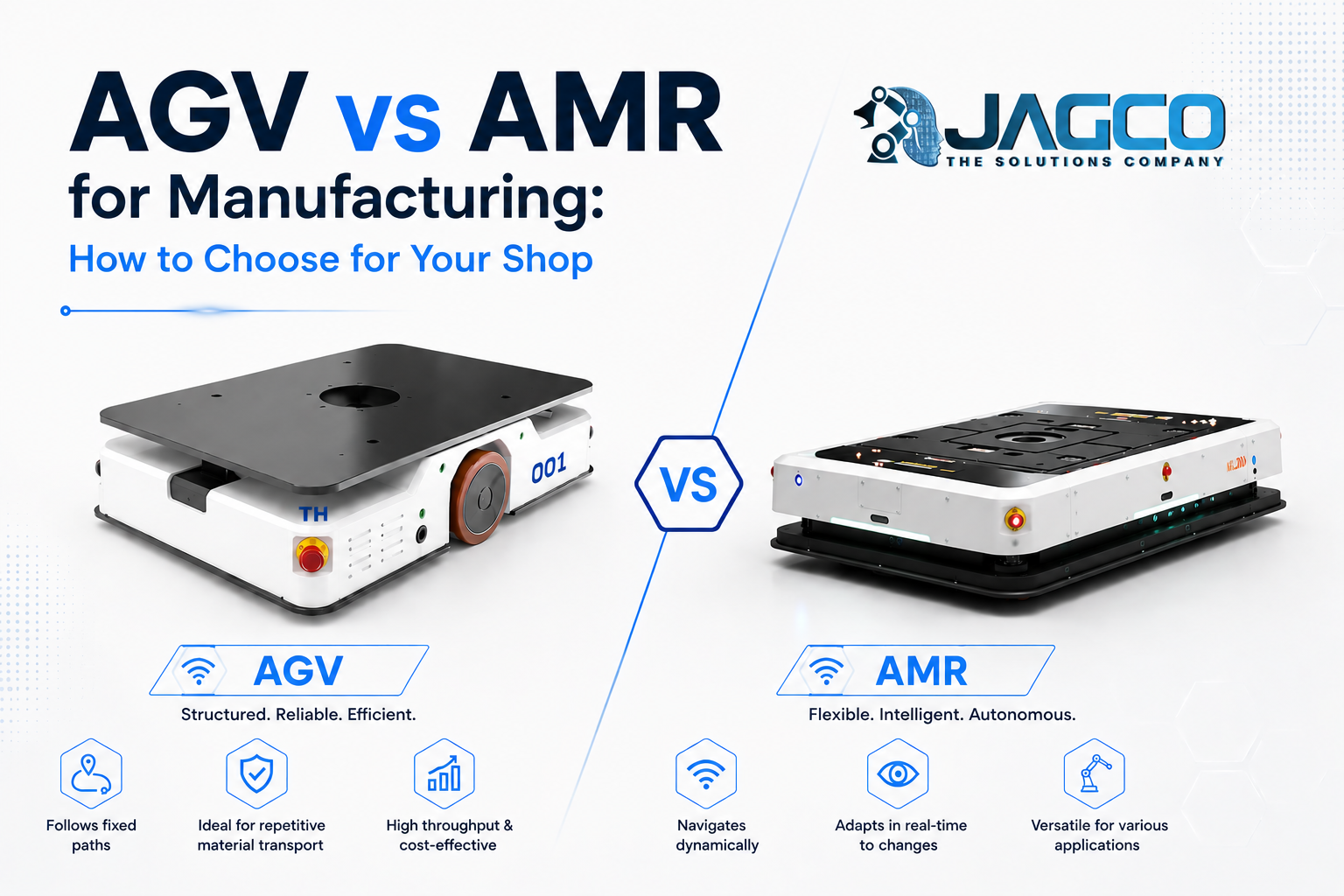
If you're a 50,000 sq ft fab shop trying to choose between AGVs and AMRs, the honest answer is this: AGVs win when your material flow paths are stable, high-volume, and repetitive. AMRs win when your layout shifts more than once a year, when humans share the floor heavily, or when you need to redeploy robots between cells without rewiring the building. Most shops we deploy in this size range end up running a mix — fixed-route AGVs on backbone runs, AMRs handling the dynamic cell-to-cell work.
Material handling has quietly become the throughput constraint in a lot of fab shops. Pressure on output is up, available labor is down, and walking parts between cells is one of the most visible forms of waste on the floor. The U.S. Bureau of Labor Statistics tracks material moving as one of the largest occupational categories in manufacturing, and the cost of a forklift operator or material handler has climbed meaningfully over the last five years
There's also a second-order effect that hits welding-heavy shops specifically. With 320,500 new welders needed by 2029 according to the American Welding Society, and 81% of manufacturers reporting they can't find skilled welders (NAM), you can't afford to have your remaining welders walking pallets across the shop. Every minute a skilled welder spends moving steel is a minute they're not welding — which is part of why we see fab shops pairing material handling automation with cobot welding systems to keep skilled hands on skilled work.
That's the real driver behind the AGV/AMR conversation in shops your size. It isn't about loving robots. It's about keeping skilled hands on skilled work.
Here's how we frame it when we sit down with a plant manager and walk a 50,000 sq ft floor:
The technology choice isn't really the decision. The decision is about your floor.
Before we quote a project, we ask plant managers to run a 30-day material flow audit. It doesn't need to be sophisticated. A clipboard works. You're answering five questions:
If your shop runs stable, repetitive flows on two or three shifts with limited human traffic on the main routes — AGVs. If your floor plan is alive, your engineers reroute parts monthly, and humans share every aisle — AMRs. If you're a typical 50,000 sq ft fab shop with a mix of both conditions, you're a hybrid candidate, and that's what we deploy most often.
Our AGV and AMR product line covers both ends, so the recommendation we give isn't filtered by what we happen to sell.
Five things we see derail AGV and AMR projects in shops this size:
WMS/MES integration cost. The robots are the visible budget. The integration with your warehouse management or manufacturing execution system is the invisible one. Plan on 20-30% of total project cost for software integration, dispatch logic, and IT work. Skip this and you'll have expensive robots running blind.
Charging strategy. Opportunity charging (top-ups during idle time) requires more chargers and tighter dispatch logic. Battery swap requires labor and floor space.
Throughput math that ignores wait time. Cycle time on a robot doesn't equal throughput. A unit that delivers a load in 4 minutes but waits 6 minutes for someone to unload is a 10-minute throughput unit. Most pro formas we see ignore this. Real throughput requires modeling pickup and drop-off station behavior, not just travel time.
Floor and environment. Fab shops are not Amazon warehouses. Slag, arc flash, overhead crane shadows, dust, and shifting pallets all affect navigation reliability. AMRs handle dynamic obstacles better; AGVs handle dirty floors better. Walk your floor before you spec a system, not after.
Safety zoning and forklift coexistence. ANSI/RIA R15.08 covers safety requirements for industrial mobile robots, and OSHA's powered industrial truck standard 1910.178 still applies if you're running forklifts alongside mobile robots. Mixed-fleet shops need clear zoning, marked aisles, and operator training.
A typical AGV system for a shop this size runs $150K-$400K all-in (units, infrastructure, integration, dispatch software), depending on fleet size and complexity. AMR systems for the same shop typically land $200K-$500K all-in, with the premium coming from per-unit hardware cost offset by lower infrastructure cost. For accurate numbers, we run a site evaluation before quoting.
Yes, and we deploy hybrid fleets regularly. The trick is dispatch logic — both systems need to coordinate through a fleet manager that prevents collisions and assigns the right vehicle to the right task. AGVs handle the predictable backbone work; AMRs handle the variable cell-to-cell jobs. Done well, this gives you the cost advantage of AGVs on high-volume routes without losing the flexibility of AMRs where you need it.
With the right sensor package, yes. Arc flash can interfere with some optical guidance systems, and slag on the floor will destroy magnetic tape over time. We typically spec wire-guided or reflector-based navigation in heavy welding areas and route AGVs around the worst spatter zones rather than through them. AMRs using LIDAR are generally more tolerant of arc flash but more sensitive to reflective puddles on the floor.
For a two-shift fab shop, we typically see 18-30 month payback on material handling automation, driven mainly by labor reduction or reallocation. Three-shift operations or shops replacing contract material handlers see 12-18 month payback. Single-shift operations rarely justify either system on labor alone — they need a secondary driver like throughput or safety.
Most fab shops this size run 2-5 mobile robots, depending on flow volume and shift count. The number is driven by cycle time and dwell time at stations, not square footage. A 50,000 sq ft shop with 3 short backbone routes might need 2 AGVs; the same square footage with 12 variable cell-to-cell flows might need 5 AMRs.
ANSI/RIA R15.08 is the current U.S. standard covering industrial mobile robots. OSHA 1910.178 still applies to any forklift activity on the same floor, and your insurance carrier may have additional requirements. We handle the safety integration as part of every deployment, including risk assessments and operator training.
The hardware doesn't transfer, but the integration work — WMS/MES connections, dispatch logic, station design — largely does. The bigger question is whether you got the diagnosis right the first time. We'd rather spend two weeks on a flow audit upfront than retrofit a $300K system 18 months in.
The reason most AGV vs AMR conversations go sideways is that the rep on the phone only sells one of them. We deploy both, which means our recommendation is based on your floor, not our product line. If you're sizing a material handling project for a fab shop in the 50,000 sq ft range, send us a layout and a rough flow map and we'll give you an honest read on which technology fits — or whether you should be running a hybrid fleet.
Email rfq@jagco.com or request a site evaluation through our contact page.
Let's discuss how we can help you with your automation needs.
.jpg)


