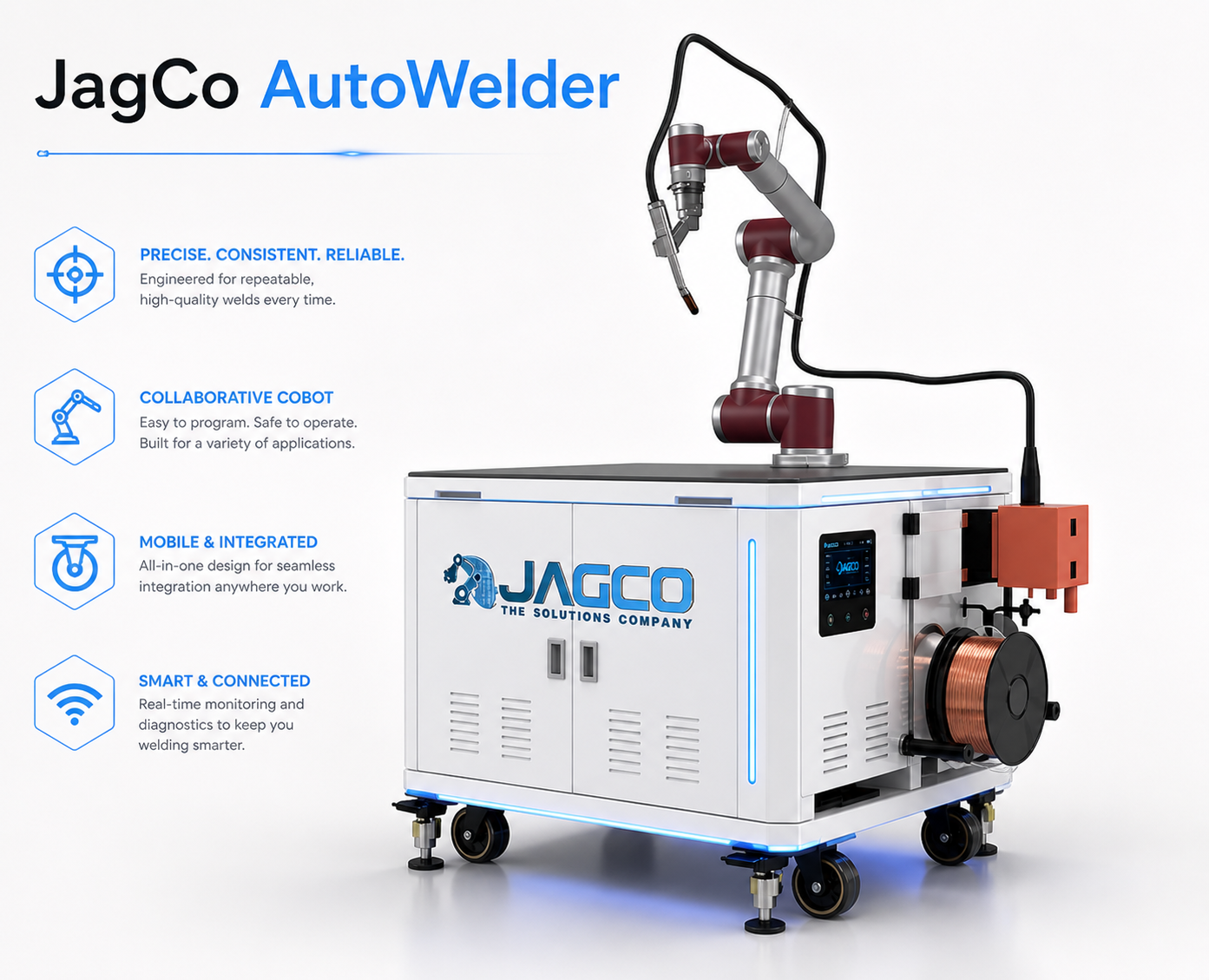
Short answer: For most fabrication shops, a cobot welder is worth it. A typical cobot welder costs between $80,000 and $150,000, pays for itself in 12 to 24 months, and directly addresses the U.S. welder shortage of 320,500 unfilled positions projected by 2029. High-utilization shops running multi-shift cobot welding operations often see payback in under 12 months.
This guide breaks down cobot welder ROI, cobot welder cost, payback period math, and how plant managers and ops directors can build a credible business case for cobot welding automation.
A cobot welder (collaborative robot welder) is a force-limited robotic welding system designed to work safely alongside human welders without a full safety cage. Unlike traditional industrial welding robots, a cobot welder is programmed by hand-guiding the torch — meaning your existing welders can teach the system in minutes rather than requiring a dedicated robot programmer. Cobot welders handle MIG, TIG, and pulsed welding processes and are ideal for the high-mix, low-volume fabrication work most U.S. shops actually run.
Before the cobot welder ROI math matters, the labor math has to.
The American Welding Society projects roughly 320,500 new welding professionals will be needed in the U.S. by 2029 — about 80,000 unfilled welding positions per year. The average welder in the U.S. is 55 years old, and the pipeline of younger workers entering the welding trade isn't keeping pace with retirements. The National Association of Manufacturers has reported that more than four in five manufacturers can't find the skilled welders they need.
What this welder shortage looks like on your floor:
This is the operating environment cobot welding automation was built for. A cobot welder doesn't replace your skilled welders — there aren't enough skilled welders to replace. A cobot welder multiplies the welders you already have.
For the high-mix, low-volume work most U.S. fabrication shops run, cobot welding wins on every line that matters: cost, deployment speed, programming time, and payback period.
JagCo's Jaka-based cobot welding system runs approximately $100,000 and includes the cobot arm, welder, wire feeder, default welding table, and welding software. Industry pricing for comparable cobot welders generally falls between $80,000 and $150,000. The complete deployed cost depends on what's added beyond the base system — primarily fixturing for your specific parts, fume extraction, and any custom integration work.
A useful rule of thumb: estimate roughly 2–3x the bare cobot welder price to get to a fully deployed cobot welding cell. Complete cobot welder cost typically includes:
For most U.S. buyers, cobot welding equipment qualifies for Section 179 expensing, which can let you deduct the full cobot welder purchase price in the first year. This materially changes the after-tax cobot welder ROI calculation. Talk to your CFO or tax advisor before you build the financial model.
For most fabrication shops, cobot welder ROI hits payback in 12 to 24 months. High-utilization shops — running multiple shifts or replacing premium-priced contract welding — frequently see cobot welder payback in under 12 months. Some shops in marine and heavy fabrication have reported full cobot welder payback on a single major contract.
Cobot Welder Payback Period (months) = Total Cobot Welding System Cost / Monthly Net Benefit
Cobot welder ROI is driven by four levers:
1. Throughput multiplier. A cobot welder doesn't replace a welder; it lets one welder oversee far more arc-on time. Real-world cobot welding throughput gains range from 2x to 6x on suitable parts. One commonly cited example: a shop moving from one part every 20 minutes to six parts every 20 minutes after deploying a cobot welder.
2. Shift expansion. Your manual welders work one shift. A cobot welder can run a lights-out second shift or weekend production with limited supervision. Multi-shift cobot welding alone can cut payback in half versus single-shift use.
3. Reduced rework and scrap. Cobot welding produces consistent torch angle, travel speed, and stick-out, leading to fewer rejects. The cobot welder ROI here is harder to quantify until you measure your current rework rate, but it's real.
4. Capacity to take on work you'd otherwise turn down. This is the lever finance teams forget. If your shop is currently saying no to fabrication contracts because you can't staff them, the cobot welder's ROI isn't just labor savings — it's the gross margin on revenue you couldn't previously serve.
A $120,000 cobot welder that doubles a $35/hour loaded welder's output across 1,800 production hours per year generates roughly $63,000 of additional capacity value annually. Add a partial second shift and you're under 18 months of cobot welder payback before factoring in quality and recruiting savings.
Build the cobot welder ROI model with conservative assumptions. If it still works at 70% of projected benefits, you have a defensible business case.
Cobot welding isn't right for every job. The shops that see the strongest cobot welder ROI share a few characteristics:
If you can check three or more, cobot welder ROI is likely to work for your shop. If not, it doesn't mean you shouldn't deploy welding automation — it means there's process work to do first.
Three things consistently catch cobot welder buyers off guard:
Fixturing is the real project. The cobot welder is the visible part of the investment, but most of the engineering effort goes into how the part is held. Underbudget cobot welding fixturing and your timeline slips.
Don't automate a broken process. If material flow, scheduling, or fit-up is inconsistent, the cobot welder exposes those problems rather than fixes them. Walk the line first. Sometimes the welding bottleneck isn't the welding.
Welders generally don't quit — they level up. The fear that cobot welding will trigger walkouts rarely materializes. What we consistently see is that welders shift into cobot operator and programmer roles, take more pride in the cell's output, and stay longer because the work is less physically punishing.
JagCo's Jaka cobot welder system starts at approximately $100,000 and includes the cobot arm, welder, wire feeder, default welding table, and welding software. Industry pricing for comparable cobot welders ranges from $80,000 to $150,000. Deployed cost depends on additional fixturing, fume extraction, and integration needs specific to the parts being welded.
Most fabrication shops see cobot welder payback in 12 to 24 months. Shops running multi-shift cobot welding operations or replacing high-cost contract welders frequently achieve cobot welder ROI in under 12 months. Some heavy fabrication shops have reported full payback on a single contract.
Yes — cobot welders are particularly well-suited to small and mid-sized fabrication shops because the upfront cobot welding system cost is significantly lower than traditional welding robots, and welders can program the cobot themselves without hiring a dedicated robotics engineer.
No, and that's not the goal. A cobot welder is a force multiplier for your existing welders. It handles repetitive welding tasks while your skilled welders focus on complex fit-up, quality oversight, and high-value custom work that still requires human judgment.
Welders at fabrication shops have reported programming new parts on a cobot welder in roughly four minutes by hand-guiding the torch through the weld path. The same job on a traditional welding robot would take an hour or more and typically requires a dedicated programmer.
Cobot welders handle MIG welding, TIG welding, pulsed welding, and flux-cored arc welding. Most cobot welding cells are configured around a primary process at deployment, though tool-changer-equipped systems can switch between welding, plasma cutting, and material handling.
Most cobot welders do not require a full safety cage because they are force-limited and stop on contact. However, welding-specific safeguards — arc flash shielding, fume extraction, and proper PPE for nearby operators — are still required. A cobot welder safety assessment should always be part of your deployment plan.
If you're at the stage of building a cobot welder business case, start with three numbers from your own floor:
Those three figures determine whether the rest of this conversation is academic or urgent.
If you'd rather not build the cobot welder ROI spreadsheet alone, JagCo's AutoWelder cobot welding system is purpose-built for the high-mix, ROI-sensitive use case described above. We've deployed cobot welding solutions across aerospace, automotive, battery and powertrain, heavy equipment, and contract fabrication shops — and we're happy to walk through your parts and your cobot welder ROI numbers before you commit to anything.
Schedule a working session with a JagCo cobot welding engineer and bring your most-welded part. We'll tell you honestly whether a cobot welder is the right answer for your shop.
Scan with your phone camera, or tap the link below each code.
Let's discuss how we can help you with your automation needs.
.jpg)